
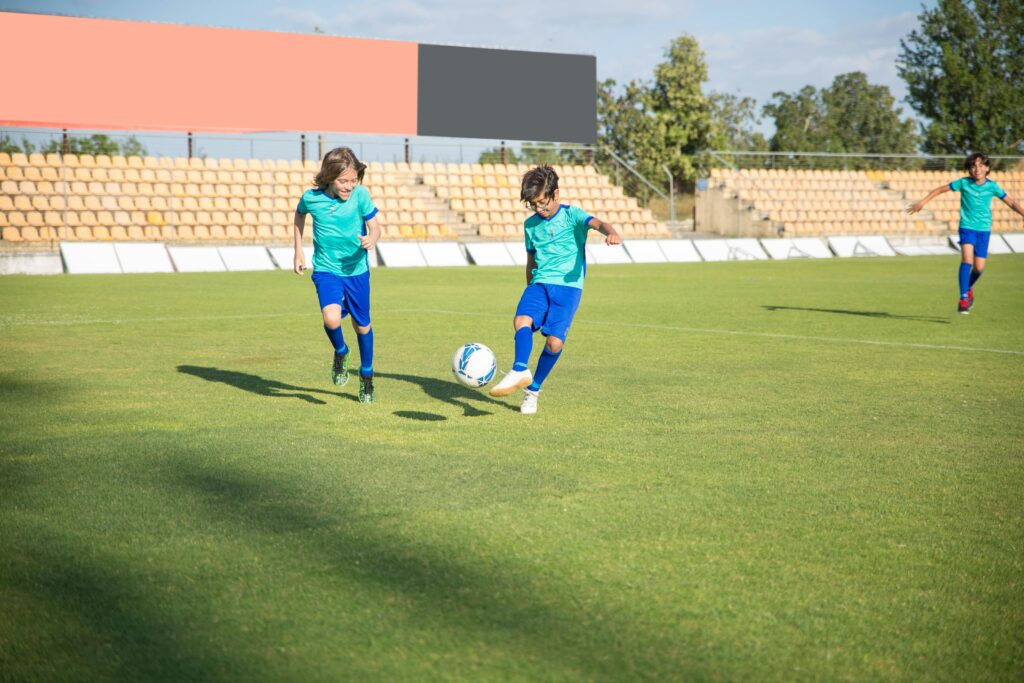
At ages 7–10, kids are at the perfect stage to develop strong soccer ball control skills. They’re eager to learn, have improving coordination, and respond best when practice feels like play. Coaches and parents can make training both fun and effective by focusing on age-appropriate drills that build dribbling, first touch, and confidence with the ball.
1. Red Light, Green Light (Dribbling Control)
One of the easiest ways to get kids comfortable with dribbling is to turn it into a game they already know. Red Light, Green Light encourages quick reactions, close control, and bursts of speed—all while making practice feel like recess.
- Setup: Each player has a ball. Line them up on one end of the field.
- How to Play:
- Coach calls “green light” → players dribble forward.
- “Red light” → players must stop and keep the ball under control.
- Add “yellow light” for slow dribbling.
- Skill Focus: Close control, stopping quickly, accelerating with the ball.
- Why It Works: Kids love the game feel—it sneaks in repetition while keeping their attention.
2. Dribble Obstacle Course
Nothing gets kids excited like racing through an obstacle course. By weaving in cones, gates, and challenges, you can disguise skill work as a game while sharpening dribbling, turning, and quick touches.
- Setup: Use cones, flags, or even backpacks to create zigzags, gates, and turns.
- How to Play: Players dribble through the course as quickly as they can while keeping control. Time them for fun competition.
- Variations:
- Add a “gate” where they must perform a move (scissors, step-over).
- Make it a relay race in teams.
- Skill Focus: Dribbling in tight spaces, ball control while changing direction.
- Why It Works: It mimics real-game situations where kids must navigate defenders.
3. Simon Says (Soccer Ball Control Edition)
This classic playground game gets a soccer twist. Simon Says with a ball helps players practice listening, quick reactions, and soccer ball control mastery—without even realizing they’re training.
- Setup: Every player has a ball in a marked space.
- How to Play: Coach (or a player leader) gives commands:
- “Simon says toe taps!” → players tap tops of the ball.
- “Simon says dribble in a circle!” → players move around their ball.
- Mix in trick commands without “Simon says” to catch players off guard.
- Skill Focus: Ball mastery, footwork variety, focus, and agility.
- Why It Works: It combines skill development with laughter and keeps kids alert and engaged.
4. Soccer Ball Control Mastery Stations
Sometimes the best way to improve touch is through repetition—but repetition doesn’t have to be boring. Ball mastery stations break skills into bite-sized challenges, letting kids rotate quickly and rack up hundreds of touches in just a few minutes.
- Setup: Create 3–4 “stations,” each with a different ball-control challenge.
- Examples of Stations:
- Toe taps (alternating feet tapping the top of the ball).
- Foundations (tapping the ball between feet).
- Inside/outside touches.
- Pull-backs and turns.
- How to Play: Kids rotate through stations every 1–2 minutes.
- Skill Focus: First touch, balance, rhythm, comfort with both feet.
- Why It Works: High repetition in short bursts keeps players engaged and maximizes touches.
5. Gates Dribbling Challenge
This simple but versatile drill builds confidence with dribbling, vision, and decision-making. By turning the field into a maze of “gates,” players learn to move with purpose while keeping the soccer ball under control.
- Setup: Place cones in pairs around the field to form multiple “gates.” Every player has a ball.
- How to Play: Players dribble through as many gates as possible in a set time (30–60 seconds).
- Variations:
- Give each gate a different move to complete before passing through.
- Add defenders to make it more challenging.
- Skill Focus: Dribbling with awareness, changing direction, first touch.
- Why It Works: Encourages creativity, keeps kids moving, and adds variety since no two rounds are ever the same.
Coaching Tips
- Keep drills short and fast-paced—kids at this age lose focus quickly.
- Always use a ball per player when possible. The more touches, the better.
- Mix in fun “game-style” drills with skill stations to balance structure and creativity.
- Celebrate effort and creativity, not just winning the game.
Soccer ball control is the foundation of every soccer skill. By mixing fun, competitive games with focused repetition, you can help 7–10-year-olds build the confidence they need to succeed on the field. Remember: if kids are smiling, they’re learning.
Interested in more soccer drills for your team, or your kid? Check out this article: 5 Soccer Drills Your Team Will Actually Love.
Pingback: The World Cup Effect: 7 Lessons Young Athletes Can Learn From the World's Biggest Tournament