Flag football is a great way to introduce kids to the passing game. Because there is less blocking and no tackling, flag football passing plays need to rely on timing, spacing, and simple routes rather than complicated formations.
The best youth flag football passing plays are easy to learn, give the quarterback clear options, and create space so kids can run after the catch.
We’ve talked on Youth Playbook about effective running and passing plays before. But focusing in on passing, here are several simple, proven flag football passing plays youth coaches can install quickly.
First Things First: Install a Flag Football Route Tree
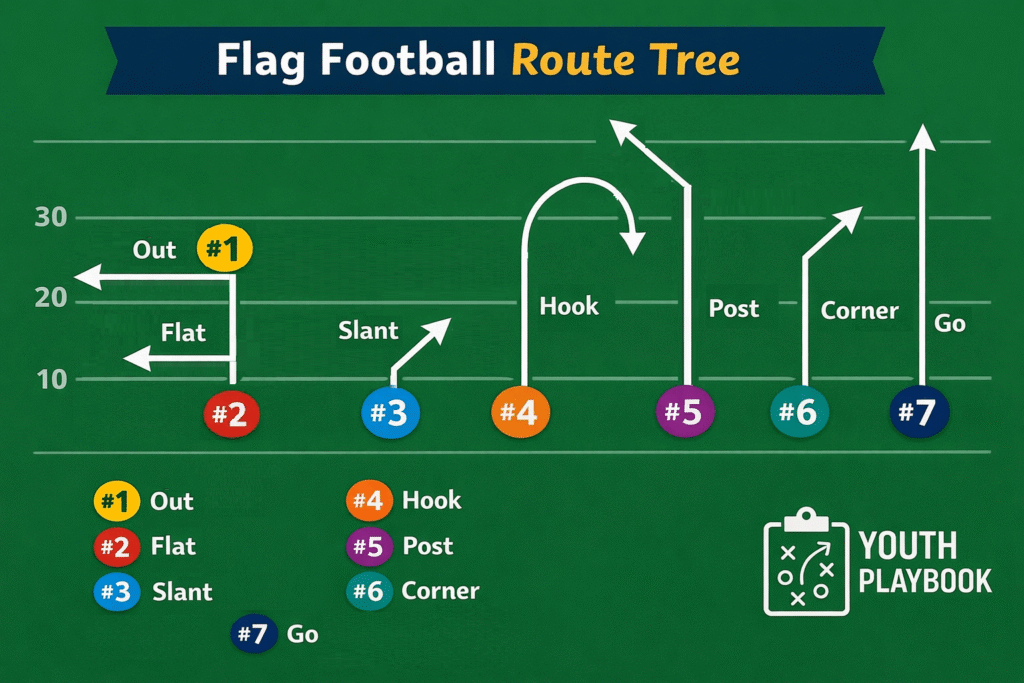
Before installing a lot of flag football passing plays, it helps players understand the basic routes receivers run. Coaches call this a route tree.
A route tree is simply a group of standard receiver routes. Once players know these routes, you can combine them to create dozens of different flag football passing plays without teaching an entirely new play each time.
For youth teams, the route tree should stay simple. Most offenses only need 6–8 basic routes.
Here are the most common routes used in flag football passing plays:
Flat Route
The receiver runs straight toward the sideline immediately after the snap. This is a quick throw that works well when the quarterback needs to get the ball out fast.
Slant Route
The receiver runs forward a few steps and cuts diagonally toward the middle of the field. Slants are one of the most effective routes in youth flag football passing plays because they develop quickly.
Out Route
The receiver runs upfield and then breaks sharply toward the sideline. This route is great for attacking space near the boundary.
Hook (or Curl) Route
The receiver runs upfield and then stops, turning back toward the quarterback. Hook routes give the quarterback an easy target if deeper routes are covered.
Post Route
The receiver runs upfield and then angles toward the center of the field. This route is often used to attack deeper areas of the defense.
Corner Route
The receiver runs upfield and breaks toward the sideline corner of the field. This route works well when defenses focus on the middle.
Go Route
Sometimes called a “fly route,” the receiver runs straight down the field looking for a deep pass.
Simple Flag Football Passing Plays That Work
Now let’s get into it. Good youth flag football passing plays typically:
- Give the quarterback two quick options
- Spread defenders across the field
- Use short routes that develop quickly
- Allow receivers to run in open space
Young quarterbacks often have 2–3 seconds to throw, so routes that break quickly are much more effective than long-developing plays.
1. The Slant–Out Combo
Concept: One receiver cuts inside while the other breaks outside.
How it works
- Receiver 1 runs a 3-step slant toward the middle.
- Receiver 2 runs a quick out route toward the sideline.
- The center releases into the flat as a safety valve.
Why it works
Defenders often chase the inside slant, leaving the outside receiver open.
Quarterback read
- Look for the slant first
- If covered, throw the out route
- If pressure comes, dump it to the center
2. Crossing Routes
Concept: Two receivers cross the field, creating confusion for defenders.
How it works
- Receiver 1 runs a shallow cross from left to right.
- Receiver 2 runs a shallow cross from right to left.
- The center runs straight upfield.
Why it works
Young defenders often follow the wrong player when routes cross.
Coaching tip
Tell receivers to run just a few yards past the line of scrimmage so the ball comes out quickly.
3. The Corner Route Play
Concept: Attack the corner of the field where defenders rarely cover well.
How it works
- Outside receiver runs 10 yards then breaks toward the corner
- Inside receiver runs a short hook
- Center runs a flat route
Why it works
Youth defenses often leave the deep sideline open.
Quarterback read
- Deep corner
- Hook route
- Center in the flat
4. The Flood Play
Concept: Overload one side of the field with multiple receivers.
How it works
Three receivers attack the same sideline at different depths:
- Receiver 1: Deep route
- Receiver 2: 10-yard out
- Center: Short flat route
Why it works
One defender cannot cover three levels.
Quarterback read
High → medium → short.
5. The Stop-and-Go (Great for Older Youth)
Concept: A double move that tricks defenders.
How it works
- Receiver runs 5 yards and stops
- Defender moves forward
- Receiver bursts deep
Why it works
Youth defenders often react aggressively to short routes.
Coaching tip
Use this sparingly so defenders don’t expect it.
Tips for Teaching Flag Football Passing Plays to Kids
Coaching youth flag football is less about complex schemes and more about helping players succeed.
Focus on these fundamentals:
1. Teach Route Landmarks
Instead of exact yardage, use simple cues like:
- “Run to the cone”
- “Break when you reach the hash”
2. Repetition Beats Complexity
A team running 3 plays well will beat a team running 10 plays poorly.
3. Keep Routes Short for Flag Football Passing Plays
Short passes help young quarterbacks succeed and allow receivers to run after the catch.
4. Practice Timing
Have quarterbacks and receivers practice together so the ball comes out before the receiver turns.
Want to check out more flag football plays? Check out our article on winning flag football plays every team should run.
Flag Football Passing Plays: Simple Plays For Day One
Flag football is a great way to introduce kids to the passing game. Because there…
Top 5 Winning Flag Football Plays Every Youth Team Should Run
Flag football success at the youth level comes down to simplicity, spacing, and execution. You…
Youth Flag Football Practice Equipment Guide for Coaches and Parents
Flag football is one of the fastest-growing youth sports in the country—and for good reason….

Top Youth Football Equipment to Buy this Season: A Parent’s Guide
The start of youth football season is exciting — new teammates, game-day energy, and plenty…

Youth Football Practice Made Easy: Coaching Ages 6–10
Coaching youth football is about more than just teaching the game—it’s about creating an environment…