
Flag football success at the youth level comes down to simplicity, spacing, and execution. You don’t need a 40-page playbook to win games — you need a handful of reliable flag football plays your players understand and can run confidently. The best youth offenses create misdirection, force defenders to move side to side, and give the quarterback quick, clear reads.
Below are five proven flag football plays that consistently work for youth teams. Each one is simple to install, easy to teach, and difficult for young defenses to stop.
1. Crossbuck (Misdirection Run)
The Crossbuck is a classic misdirection run that works extremely well in youth flag football. The quarterback lines up under center or in shotgun with two running backs positioned on either side. At the snap, the quarterback opens toward one running back and clearly shows the ball to that player, selling the fake handoff. That first running back continues across the formation as if carrying the ball, drawing defenders in that direction.
Meanwhile, the quarterback quickly pivots and hands the ball to the second running back moving the opposite way. The real ball carrier attacks the edge with speed while receivers seal defenders by running short routes or blocking within league rules. Because youth defenders often chase the first movement they see, this play regularly creates open space along the outside.
2. Bunch Formation Quick Pass
In the bunch formation, three receivers align tightly together on one side of the field, with the quarterback in shotgun and a center snapping the ball. The tight alignment forces defenders to communicate and often creates confusion in both man and zone coverage. At the snap, one receiver runs a quick out toward the sideline, one runs a short slant across the middle, and the third releases vertically to clear space.
The quarterback takes a quick three-step drop and reads outside to inside. The goal is a fast, high-percentage throw before the defense can react. Because routes develop quickly and players start close together, it’s harder for defenders to avoid natural traffic. This play is especially effective on short yardage and conversion downs.
3. Twin Formation Stretch (Slant + Go Combo)
The twin formation places two receivers on one side of the field and one receiver on the opposite side, spreading the defense horizontally. After the snap, the outside twin receiver runs a vertical “go” route to stretch the defense deep, while the inside twin runs a quick slant underneath. The single receiver on the opposite side runs a short hitch or out route as a safety valve.
The quarterback reads the defense’s reaction. If the deep defender stays shallow, the vertical route can become a big-play opportunity. If the defense backs up to protect deep, the slant opens underneath. This simple high-low concept teaches young quarterbacks to read coverage while giving them two strong options on one side of the field.
4. Reverse Sweep
The reverse sweep is designed to attack aggressive defenses. The quarterback hands the ball to a running back heading laterally toward one sideline. As defenders pursue, that running back hands or pitches the ball to a receiver coming around from the opposite side of the formation.
The second ball carrier accelerates around the edge with blockers or route runners sealing off defenders. Timing is critical — the exchange must happen cleanly and quickly. Because many youth defenders over-pursue, the reverse often results in wide-open running lanes on the backside of the play.
The reverse is a playbook staple for one simple fact: it works. Check out this video for more tips on the reverse (shout out to Youth Flag Football HQ!)
5. Spread Slant-Out Combo
In the spread formation, receivers are evenly distributed across the field, forcing defenders to cover sideline to sideline. On this play, one receiver runs a quick slant across the middle while another runs a sharp out route toward the sideline. A third receiver may run a vertical route to stretch coverage deep.
The quarterback reads the outside defender. If that defender protects the sideline, the slant opens inside. If the defender collapses toward the middle, the out route becomes available. This simple read makes it easy for young quarterbacks to make confident decisions while giving receivers room to gain yards after the catch.
Coaching Tip: Keep Your Flag Football Plays Simple
The biggest mistake youth coaches make is installing too many plays. Five well-practiced plays run confidently will outperform a complicated playbook every time. Focus on timing, clean exchanges, and clear quarterback reads.
When players understand their roles and execute with confidence, scoring becomes much easier — and more fun.
Want more flag football tips? Start here with our Flag Football Practice Equipment Guide.
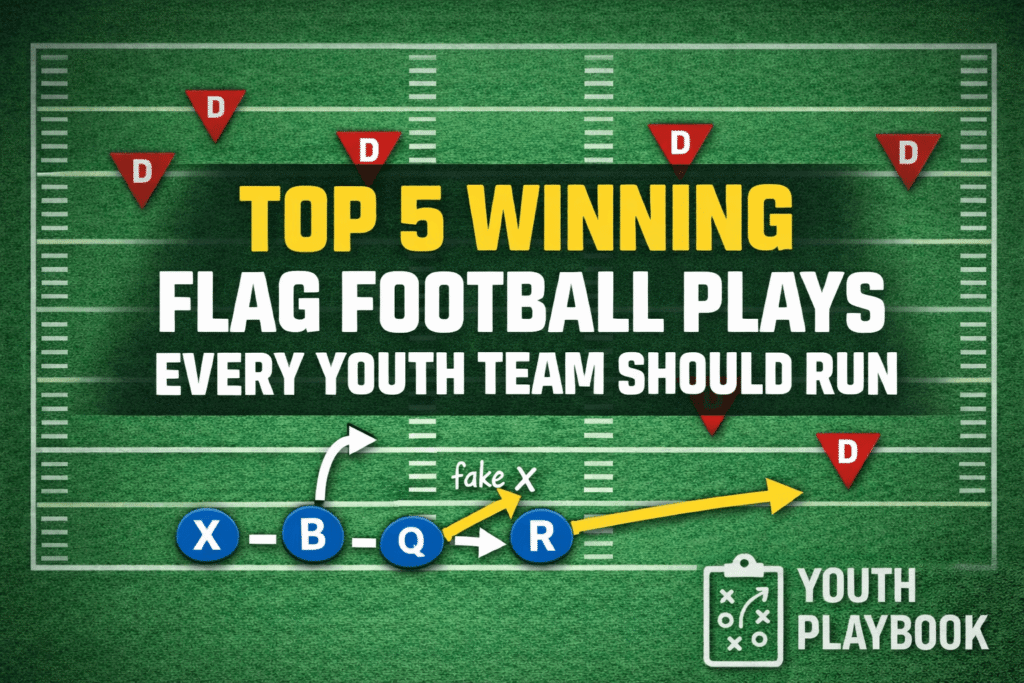
Top 5 Winning Flag Football Plays Every Youth Team Should Run
Flag football success at the youth level comes down to simplicity, spacing, and execution. You…
Youth Flag Football Practice Equipment Guide for Coaches and Parents
Flag football is one of the fastest-growing youth sports in the country—and for good reason….

Top Youth Football Equipment to Buy this Season: A Parent’s Guide
The start of youth football season is exciting — new teammates, game-day energy, and plenty…

Youth Football Practice Made Easy: Coaching Ages 6–10
Coaching youth football is about more than just teaching the game—it’s about creating an environment…